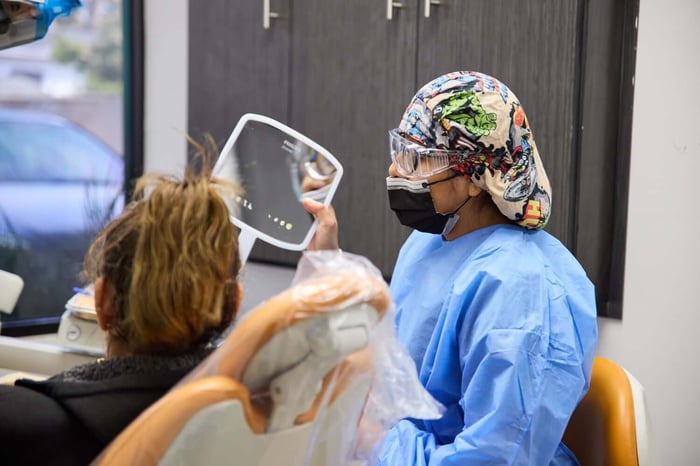
This guide has been reviewed and approved by the clinical leads at Gardena Dental Care, who specialize in advanced restorative dentistry and full-arch rehabilitation.
Losing most or all of your teeth changes more than just how you eat. It shifts how you speak, how you feel in social situations, and how you carry yourself day to day.
For patients asking when All-on-4 implants are the best full-arch solution, the short answer is: when you need a complete arch restored, want fixed teeth, and are looking for a path that avoids the limitations of a removable denture.
This full-mouth restoration offers a permanent alternative to traditional appliances. The All-on-4 dental implant approach uses four strategically placed titanium implants to anchor a full-arch prosthesis, offering a level of stability and function that removable options simply cannot match.
At Gardena Dental Care, our team of board-certified professionals draws on decades of combined experience in advanced oral surgery and restorative dentistry. We understand that exploring full-arch treatment is a significant step, which is why we guide patients through every detail. Our clinicians undergo continuous specialized training in full-arch rehabilitation to assess each person's unique bone volume, bite habits, and long-term goals before making a recommendation.
This guide covers how the All-on-4 treatment concept works, who tends to benefit most, how treatment typically unfolds from start to finish, how it compares to other ways to replace missing teeth, and what trade-offs to weigh before making a decision.
Key Takeaways
Four strategically angled implants can support a complete fixed arch, often without bone grafting.
The best candidates are patients with significant tooth loss, failing teeth, or denture frustration who have adequate remaining bone support.
Full-arch treatment involves a detailed planning phase, surgery, a healing period, and a final prosthesis placement.
Why Four Implants Can Carry A Full Arch
The engineering behind All-on-4 is more thoughtful than it might first appear. Four implants, placed at precise angles, distribute chewing forces across the jaw in a way that makes a stable full-arch prosthesis possible.
How The All-on-4 Concept Supports A Full-Arch Prosthesis
The All-on-4 treatment concept uses a specific implant layout to maximize support with minimal hardware, providing a stable foundation for full-arch restoration.
Two vertical implants are placed in the anterior region near the front of the jaw.
Two posterior implants are angled, typically up to 45 degrees, toward the back.
Together, the four implants create a stable base that anchors a fixed full-arch prosthesis.
The fixed prosthesis replaces the entire row of upper or lower teeth in one connected bridge.
This layout means edentulous patients, or those about to become edentulous, can receive a full set of fixed teeth without needing one implant per tooth.
Why Tilted Back Implants Help In Low-Bone Areas
One of the reasons the All-on-4 concept changed full-arch rehabilitation is the use of tilted posterior implants. Bone density and bone volume in the back of the jaw are often reduced in patients who have been missing teeth for a long time, because bone resorption occurs naturally when teeth are no longer present.
By angling those rear implants, clinicians can reach areas with denser, more available bone. This is why the All-on-4 treatment concept can often avoid bone grafting entirely, something that traditional full-arch implant approaches have historically required.
Tilted implants also extend the effective implant-supported bridge span. This reduces the cantilever stress on the prosthesis while keeping the implant footprint compact.
How Fixed Teeth Compare With A Removable Denture
Patients who have worn removable dentures often describe a shift in confidence and function when they move to a fixed prosthesis. The comparison is meaningful.
Feature | Fixed Full-Arch Prosthesis | Removable Denture |
|---|---|---|
Stability during chewing | High | Variable |
Requires removal at night | No | Often yes |
Bone preservation | Supported by implants | Minimal support |
Adhesives needed | No | Sometimes |
Feel compared to natural teeth | Close | Less natural |
Adjustment period | Moderate | Often longer |
Overdentures and implant-supported removable options do offer more stability than traditional removable dentures, but a fixed prosthesis anchored by implants is the option that most closely replicates the feel and function of natural teeth.
The Sweet Spot: Who Tends To Be A Good Fit
Not every patient needs or benefits from full-arch treatment. The right candidate is someone whose clinical picture genuinely calls for it.
When Bone Loss Still Leaves Enough Support
Bone loss is common in patients who have been missing teeth for years, and it is one of the first things a clinician evaluates. Significant bone resorption does not automatically disqualify someone from All-on-4 treatment, but the degree matters.
Moderate bone loss: often manageable with angled posterior implants to find denser bone.
Severe bone loss in the posterior may require grafting or a different full-arch approach.
Bone density assessment: done through imaging to confirm adequate bone volume for implant stability.
Long-term edentulous patients: often still candidates, but a thorough CBCT scan is essential.
The key question is not whether bone loss exists, but whether enough quality bone remains in the right locations to support four implants securely.
Why Failing Teeth And Denture Frustration Often Point Here
Some patients arrive having struggled for years with teeth that keep breaking down. Others come in frustrated with dentures that slip, cause sore spots, or limit what they can eat. These are two of the most common scenarios where full-arch implant treatment becomes a genuinely practical conversation.
Gum disease that has compromised multiple teeth, or a mouth full of cracked and heavily restored teeth with poor long-term prognoses, often makes the case for a clean-slate full-arch approach. Treating teeth one at a time in that situation can extend discomfort and cost over many years without resolving the underlying picture.
Patients currently wearing full removable dentures who want fixed teeth are also strong candidates, especially when denture fit has become a persistent problem.
When Bruxism, Clenching, Or Heavy Bite Forces Change The Plan
Parafunction, meaning habits like bruxism, clenching, or irregular chewing cycles, deserves a direct conversation.
These habits can significantly impact your occlusion and the longevity of the restoration. Occlusal forces transmitted through implants are handled differently than through natural teeth, which have a periodontal ligament providing some cushioning and sensory feedback.
Patients with heavy bite forces or confirmed bruxism are at higher risk for prosthesis fractures, implant stress, and bone loss around implants over time. In some cases, a bar-supported overdenture may be a better recommendation than a fully fixed bridge.
This is because the prosthesis can be removed at night, allowing for the use of a flat-planed night guard instead. This protects both the implants and the prosthetic structure without abandoning the implant-supported concept entirely.
From Scan To Smile: How Treatment Usually Unfolds
Full-arch treatment is a multi-phase process. Each phase builds on the last, and knowing the sequence helps patients feel more prepared and less anxious.
Planning With A CBCT Scan And Smile Design
Treatment begins with a thorough planning phase led by clinicians who specialize in complex restorative cases. A CBCT scan provides a three-dimensional image of the jaw, showing bone volume, bone density, the location of the inferior alveolar nerve, and where implants can safely be placed.
CBCT imaging maps the jaw in three dimensions for precise implant planning.
Smile design helps determine tooth shape, size, and how the prosthesis will look aesthetically.
Medical history review flags any systemic factors that could affect healing or implant success.
A detailed treatment plan is presented before anything is scheduled, including a clear financial breakdown.
This planning phase is where personalized full-arch rehabilitation really begins. No two jaws are identical, and the scan data guides every implant positioning decision.
What Happens During Implant Surgery And Implant Placement
On surgery day, our surgeons apply advanced oral surgery techniques to extract any remaining failing teeth and prepare the jaw ridge. The four titanium implants are placed according to the pre-surgical plan with clinical precision. The dental implant procedure is performed under local anesthesia, with sedation options available for maximum comfort.
Implant surgery typically takes a few hours from start to finish. The posterior implants are placed at their planned angles to access denser bone and extend the support base for the prosthesis. Precision during this phase directly affects how well the prosthesis seats and how the final bite feels.
How Teeth In A Day, Immediate Loading, And Healing Fit Together
One of the most well-known aspects of this dental implant technique is immediate loading, often called "teeth in a day." This approach provides immediate function by attaching a provisional bridge shortly after surgery. A provisional prosthesis is attached to the implants on the same day as surgery, meaning patients leave with a full set of functional teeth.
Phase | Timing | What Happens |
|---|---|---|
Surgery and immediate loading | Day 1 | Implants placed; provisional prosthesis attached |
Initial healing | Weeks 1 to 6 | Soft tissue heals; diet is restricted to soft foods |
Osseointegration | Months 2 to 6 | Bone fuses with titanium implants |
Final prosthesis placement | Around 4 to 6 months post-surgery | The permanent full-arch bridge is seated |
Long-term maintenance | Ongoing | Professional cleanings and oral hygiene routines |
The provisional prosthesis protects the implants during osseointegration while giving patients functional, natural-looking teeth through the healing phase. Once integration is confirmed, the final prosthesis is fabricated and placed.
All-on-4 Vs. Other Ways To Replace Missing Teeth
All-on-4 is one of several full-arch implant treatment approaches. Understanding where it fits among other options helps patients and clinicians choose the most appropriate path.
Single Dental Implants For Individual Gaps
Single dental implants are the most direct solution when one or a few teeth are missing, and the surrounding teeth are healthy. Each implant supports its own crown, functions independently, and can be placed without affecting neighboring teeth.
Best for: patients with one to several missing teeth.
Not typically applicable when: most or all teeth in an arch need replacement.
Benefit: highly targeted; preserves adjacent tooth structure completely.
Limitation: Replacing a full arch with individual implants would require 10 or more implants per arch, which is significantly more involved and costly.
All-on-4 dental implants exist precisely because placing one implant per missing tooth is not always practical or necessary for full-arch cases.
Implant-Supported Dentures And Overdentures For Added Stability
Implant-supported dentures and overdentures sit between traditional removable dentures and fully fixed bridges on the stability spectrum. They attach to implants using snaps or a bar, offering better retention than adhesive-based removable dentures.
These options are often appropriate when a patient wants implant support but may not be a strong candidate for a fully fixed bridge, perhaps due to heavy parafunction or specific bone limitations. They can also be removed for cleaning, which some patients find more manageable. The trade-off is that they do not feel quite as natural as fixed teeth.
When All-on-6, All-on-8, or Segmented Bridges May Be Considered
All-on-4 is not the only full-arch implant approach. Some patients benefit from a higher implant count for added stability or to accommodate specific bone and load conditions.
Approach | Implants Per Arch | Common Indication |
|---|---|---|
All-on-4 | 4 | Adequate bone, standard load, streamlined treatment |
All-on-6 | 6 | More available bone, higher bite force, and added stability |
All-on-8 | 8 | Complex cases, higher forces, or larger prosthetic spans |
Segmented Bridges | 6+ | Full arch split into separate segments for easier maintenance |
More implants generally mean more distributed load and potentially more prosthetic design flexibility. The right count depends on bone volume, occlusal forces, prosthetic material choices, and what the clinician determines provides the best long-term outcome for that specific patient.
The Trade-Offs Patients Should Know Before Saying Yes
Full-arch treatment changes lives for many patients, and going in with a clear-eyed understanding of the trade-offs makes the experience much smoother.
When Bone Grafting Or Bone Reduction May Still Come Up
One of the appeals of All-on-4 is that it often avoids bone grafting. Angled posterior implants allow access to denser bone that traditional vertical placements might miss. That said, bone grafting is not always entirely off the table.
Severe bone loss in key areas may still require grafting before or at the time of implant placement.
Bone reduction (alveoloplasty) is sometimes performed to level and smooth the jaw ridge, creating a better-fitting prosthetic emergence profile.
Ridge reduction can affect how the bridge bulk feels against the soft tissue, which is worth discussing in detail beforehand.
Patients should ask specifically whether grafting or bone reshaping is anticipated for their case, so there are no surprises on surgery day.
Speech, Bridge Bulk, And Daily Cleaning Realities
The full-arch prosthesis has a physical bulk to it. That bulk is necessary for strength, but it can influence how certain sounds, particularly "D," "T," "N," and "S" sounds, are formed by the tongue.
Most patients adapt over time, but this is a real consideration that deserves honest discussion before treatment begins. Showing patients a model of the prosthesis before surgery, so they understand what it will feel like against the soft tissue, significantly reduces post-treatment surprise.
Daily oral hygiene also looks different with a fixed bridge. Floss threaders, interdental brushes, and water flossers are part of the routine. Professional cleanings are still necessary and should be scheduled regularly.
Why The Shape Of A Full-Arch Bridge Affects Speech At First
Many patients are surprised to learn that a full-arch prosthesis changes how the tongue contacts the teeth and soft tissue during speech. Certain sounds, especially “S,” “T,” and “D” sounds, may initially feel different while the tongue adapts to the shape and contour of the new bridge.
The Cleveland Clinic explains that speech adaptation is common with dentures and oral prosthetics, particularly during the initial adjustment period. Most patients gradually adapt through everyday speaking, but understanding this beforehand helps set realistic expectations and reduces frustration during recovery.
How Implant Failure And Peri-Implantitis Risks Are Lowered
Implant failure and peri-implantitis (infection around the implant) are real risks, but they are manageable with the right habits and follow-up care.
Smoking significantly increases implant failure risk and is a key factor in candidacy conversations.
Uncontrolled diabetes affects healing and osseointegration; stable systemic health improves outcomes.
Consistent oral hygiene reduces the bacterial load around implants and lowers peri-implantitis risk.
Regular professional cleanings allow the care team to monitor implant health and catch issues early.
Patients with bruxism may benefit from a night guard to reduce nocturnal loading on the implants.
None of these risks makes All-on-4 the wrong choice for appropriate candidates. They simply require awareness and commitment to long-term maintenance.
Making The Final Call Without Guesswork
Choosing full-arch treatment is a meaningful decision, and it should be made with complete information. The right recommendation is built on a thorough clinical picture, not a general assumption that one approach fits everyone.
The Questions A Dentist Reviews Before Recommending Full-Arch Treatment
Before recommending the All-on-4 procedure or any full-arch rehabilitation path, a thorough evaluation covers several key areas.
Bone volume and density: confirmed by CBCT imaging.
Periodontal health: active gum disease must be addressed before implant placement.
Systemic health: diabetes, smoking history, and medications that affect bone metabolism.
Parafunctional habits: bruxism, clenching, or heavy occlusal forces.
Number and condition of remaining teeth: are they salvageable, or is full-arch treatment the more practical path?
Patient expectations: What does quality of life look like for this person after treatment?
Each of these factors shapes the recommendation. A patient who looks like a straightforward All-on-4 candidate on paper may present differently once a full evaluation is complete.
How Materials, Budget, And Long-Term Maintenance Affect The Choice
Full-arch prosthetics come in several material options, each with different strength profiles, aesthetics, and maintenance requirements.
Material | Durability | Aesthetics | Maintenance Notes |
|---|---|---|---|
Acrylic fused to titanium | Moderate | Good | More prone to wear over time |
Monolithic zirconia | High | Excellent | Less fracture risk; harder to repair |
Porcelain on cobalt-chromium | High | Very good | Natural appearance; chipping possible |
Budget is a real part of this conversation. Full-arch implant treatment is a significant investment, and discussing financing options, material trade-offs, and realistic long-term maintenance costs upfront helps patients make decisions they feel genuinely confident about.
Why The Right Option Is Personal, Not Just Popular
All-on-4 treatment has become well-known, and many patients come in specifically asking for it. That awareness is a good starting point, but it should not drive the final recommendation on its own.
Full-arch rehabilitation is not one-size-fits-all. A patient with significant parafunction may be better served by an overdenture approach. A patient with only a few failing teeth may benefit more from targeted single implants combined with restorative work. And a patient with very advanced bone loss may need more than four implants for a stable long-term result.
The best full-arch implant treatment is the one designed around a specific patient, not a popular concept.
Frequently Asked Questions
How do I know if a full-arch implant option is right for my smile goals and comfort?
The clearest answer comes from a clinical evaluation that includes imaging and a full conversation about your goals, habits, and health history. If you are missing most or all of your teeth, have failing teeth that keep breaking down, or are struggling with a removable denture, a fixed full-arch solution is worth exploring. Your care team can walk you through what your specific bone and soft tissue picture supports.
What kinds of tooth loss or denture concerns make a fixed full-arch solution worth considering?
Patients who are fully edentulous, currently wearing a removable denture that does not fit well, or facing the loss of most of their remaining teeth are typically the strongest candidates. Persistent denture slippage, sore spots, limitations on what you can eat, and changes in jaw shape over time are all signs that an implant-supported fixed solution may meaningfully improve your quality of life.
Do I need enough healthy bone, and what happens if I've been missing teeth for a long time?
Bone volume does matter, but long-term tooth loss does not automatically rule out All-on-4 treatment. The angled posterior implants used in the All-on-4 concept are specifically designed to access denser bone that is available even when the back of the jaw has experienced bone resorption.
A CBCT scan gives a clear picture of what is present. From there, the team can advise whether the standard approach, grafting, or specialized options like pterygoid implants are most appropriate.
Can a full-arch implant approach help if my remaining teeth are failing or keep breaking down?
Yes. This is one of the most common situations where full-arch rehabilitation becomes the most practical path forward. When a significant number of remaining teeth have poor long-term prognoses due to decay, fractures, or advanced gum disease, addressing them individually over time can be more costly and drawn out than a comprehensive full-arch plan.
A thorough evaluation helps clarify whether saving some teeth makes sense or whether a clean-slate approach is more beneficial.
Choosing a fixed solution also means you are not dealing with ongoing repairs and piecemeal treatment for years to come.
What can I expect on treatment day, and how do you keep the experience comfortable and calm?
On surgery day, any failing teeth that need removal are extracted, the implants are placed according to the pre-surgical plan, and a provisional prosthesis is attached so you leave with a full set of functional teeth. Local anesthesia is used throughout, and sedation options are available for patients who want additional comfort. The team explains each step as it happens, so you are never left wondering what is coming next.
How long does the process take from consultation to having secure, natural-looking teeth again?
From your first planning appointment to your final prosthesis, the full process typically spans four to six months. The initial surgery and provisional teeth occur the same day, followed by months of healing and osseointegration, where bone fuses with titanium implants.
Once that is confirmed, the final full-arch bridge is fabricated and placed. Some patients move faster depending on healing and individual factors, but four to six months is a realistic general timeline.
Losing most or all of your teeth does not have to mean living with instability, discomfort, or limitations on what you can eat and how you smile. The All-on-4 dental implant concept offers a well-documented path to fixed, natural-feeling teeth using four strategically placed implants.
For the right patient, it represents one of the most efficient and life-changing full-arch rehabilitation options available. The key is making sure the recommendation is built around your specific anatomy, habits, and goals, not a general assumption.
Gardena Dental Care combines modern tools and personalized care to assist patients in Gardena and nearby areas with full-arch treatment confidently. From CBCT imaging and smile design to prosthesis placement, every treatment phase emphasizes transparency and your comfort.
If you are experiencing symptoms or discomfort related to failing teeth, or if you have been living with a removable denture and are ready to explore what fixed options could look like for you, our team is here to help you explore your options at your own pace. Reach out anytime to start that conversation.